
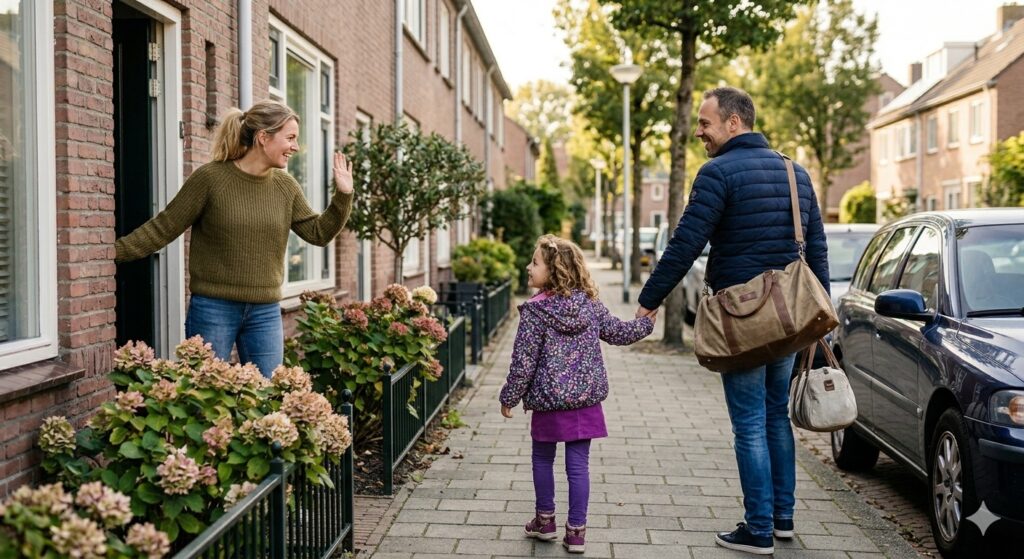
Sunday evening, bag packed, and still that knot in your stomach
It’s 6:45 PM. The bag has been sitting by the door for an hour, double-checked to make sure the stuffed animal is in there and the tablet is charged. Your child is still playing calmly, but you can already feel the tension building in twenty minutes, your ex’s car will be outside.
For many children, the handover is the most unpredictable moment of the week. Not because there’s anything wrong with either home, but because the transition itself is the moment where tension between parents is most noticeable, even when nobody says a word.
The good news: a handover doesn’t have to be tense. With a few practical choices, it becomes easier and more relaxed.
Why the handover moment is so sensitive
Children are remarkably good at picking up on tension, even the subtle kind. A quick glance, a voice that’s slightly too tight, a bag handed over too fast, kids register those signals faster than adults often realize.
On top of that, the handover is literally a transition: from one world to another, with different rules, a different atmosphere, and sometimes a different rhythm. For younger children, that shift is already a lot to process, even without any tension between parents.
The handover itself isn’t the problem, it’s the moment where unresolved tension becomes most visible. That’s exactly why it’s worth designing this moment deliberately.
What helps: consistent structure
Predictability is the single biggest factor. Children who know what to expect experience noticeably less stress than children whose handovers unfold differently every time.
Fixed time and place. A handover that happens at the same time and place every week (always at school on Friday afternoon, or always at 6 PM at the front door) gives a child something to hold onto. Some variation is unavoidable, but the more consistent the pattern, the calmer it goes.
Keep it short. For most kids, a two-minute handover feels better than a twenty-minute one. Long conversations on the doorstep, even friendly ones, stretch out the tense moment. Practical matters (medication, a school note, something worth flagging) can often go through an app or a short message instead of happening live on the threshold.
A small ritual. Some families build in a tiny ritual: a high five, a fixed phrase (“see you next week, love you”), or something to bring to the other house. For younger children, that kind of recognizable moment is often reassuring.
What helps: the handover itself
Keep the tone neutral, even when it’s hard. Children pick up on emotional charge even when it isn’t directed at them. A neutral, friendly tone between parents, even in a strained relationship, makes the handover much lighter for the child.
Don’t ask questions right at pickup. “How was it at mom’s/dad’s?” asked right at the door can put a child in an awkward spot — caught between loyalty to one home and honesty toward the other. That kind of question can wait, asked more casually later, over dinner.
Use a neutral location if things are tense at home. When tension between parents is ongoing, handing over at school, at after-school care, or at a grandparent’s can be a good middle ground, the child doesn’t have to witness a strained interaction between parents.
What helps: practical preparation
A lot of handover tension isn’t emotional at all, it’s practical chaos: forgotten school supplies, a missed appointment nobody mentioned, an empty medication box. That kind of practical friction is usually easier to fix than the emotional side and clearing it up removes a lot of irritation from the doorstep.
A fixed checklist helps: school bag, sports gear, medication, charger, stuffed animal. Some parents keep a “standard set” at both homes (toothbrush, pajamas, basics), so there’s simply less to shuttle back and forth.
How Harmoneaz helps with the handover
Harmoneaz is built to take the practical load off the handover moment, so the doorstep is left free for a calm transfer instead of a last-minute update.
- Shared calendar with appointments — both parents see all of the kids’ appointments in one shared, kid-focused calendar.
- Task tracking — practical to-dos like “book a physio appointment” or “buy new shoes” can be created right in the app.
- Daily notes — details about the past few days or how the child was feeling can be logged day by day, so both parents stay informed without having to discuss everything in front of the child(ren).
- Packing list — a packing list for the handover so nothing gets forgotten, with the option to add one-off items too.
By sorting out the practical side in advance, the handover itself stays short and predictable — exactly what a child needs.


Further reading (external sources)
- Rijksoverheid (Dutch government) — parenting plans and contact arrangements
- MfN (Mediatorsfederatie Nederland) — mediation support for ongoing tension around handovers
- vFAS (Vereniging van Familierecht Advocaten Scheidingsmediators) — legal advice for disputes over contact arrangements
Also read: Co-parenting schedules explained: which model works for you? · The best way to track co-parenting arrangements (coming soon)